
TDI's Mission Statement
"To promote equal access in telecommunications and media for people who are deaf, hard of hearing, late deafened, or deaf blind."
What Did TDI Do?
- Educate & encourage consumer involvement in their rights to telecommunications and media accessibility
- Provide technical assistance & consulting to industry, associations, and individuals
- Encourage accessible applications of existing & emerging technologies in all sectors of the community
- Advise on & promote the uniformity of standards for telecommunications and media technologies
- Network and collaborate with other disability organizations, government, industry, & academia
- Develop & advocate for national policies which support accessibility issues
- Publish The GA-SK quarterly news magazine
- Publish the annual Blue Book, TDI National Directory & Resource Guide for Equal Access in Telecommunications and Media for People Who Are Deaf, Late-Deafened,Hard-of-Hearing or Deaf-Blind.
- Disseminate TDI-L eNotes to members, subscribers and friends of TDI with up-to-date news and action alerts.
TDI Awards
Robert H. Weitbrecht Telecommunications Access Award
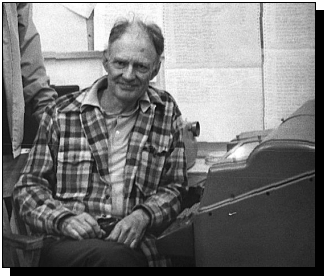
Robert H. Weitbrecht
1920 - 1983
-
Deaf physicist with an unusual avocation - amateur radio
-
Invented acoustic coupler to link Teletype machines to regular phone lines
-
Began the TTY network in 1964
This award is given biennially to an individual who has made outstanding contributions by any means to improve accessibility to telecommunications and media in the United States.
H. Latham Breunig Humanitarian Award
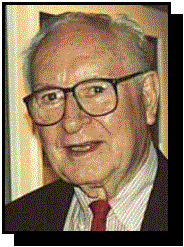
H. Latham Breunig
1910 - 1999
-
Salvaged AT&T's surplus teletype machines
-
Founded TDI Distribution Committee with his wife, Nancy, in Indianapolis, Indiana
-
Helped form TTY network
-
TDI's first Executive Director
-
Served on the President's Committee on Employment of the Handicapped
This award given biennially to an individual who has made outstanding contributions to the program or activities of TDI.
James C. Marsters Promotion Award
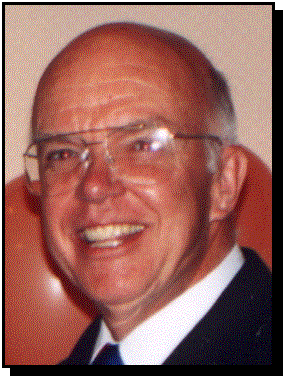
James C. Marsters
1924 -
- Orthodontist
- Encouraged Robert Weitbrecht to find a way to allow deaf people to communicate via telephone lines
- Co-founded Applied Communications Corporation (APCOM) with Robert Weitbrecht and Andrew Saks
This award is given biennially to an individual who has made outstanding contributions to improving accessibility to telecommunications and media in the United States through efforts in promotion, marketing or public relations.
Andrew Saks Engineering Award
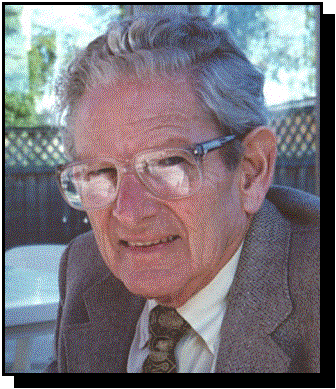
Andrew Saks
1917 - 1989
-
Provided start-up funds for APCOM to manufacture acoustic coupler modems
-
Advocated successfully to have IRS allow cost of TTYs and modems be tax-deductible as medical expense
-
Determined to build a future where deaf and hard of hearing individuals could communicate easily by phone
This award is given biennially to an individual who has made outstanding contributions to improving accessibility to telecommunications and media in the United States through efforts in design, electronics or engineering.
I. Lee Brody Lifetime Achievement Award
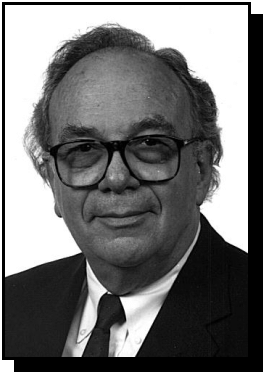
I. Lee Brody
1926 - 1997
-
Made telecommunications access affordable to the masses through his company, Phone-TTY
-
Forward thinker and visionary
-
Provided news service for NYC area
-
His greatest contribution - PC hardware and software used widely in TRS around the US
-
Developed Braille TTY
This award is given biennially to an individual who has devoted significant time and energy over an extended number of years to improve accessibility to telecommunications and media in the United States.